
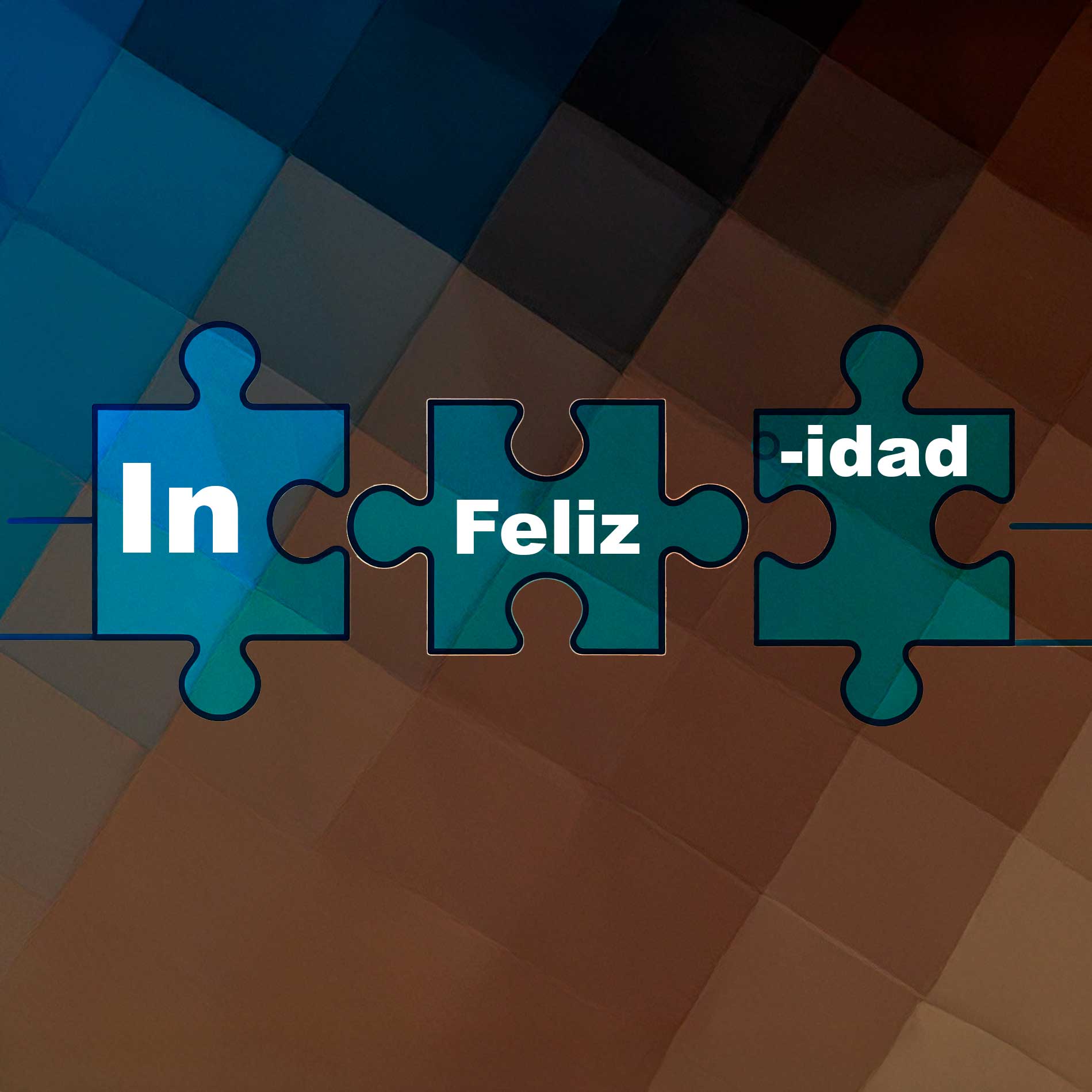
Every Spanish word you have ever learned was built from smaller pieces. Not letters: pieces that carry meaning.
Take hablar. Inside it there is habl-, which carries the idea of speaking, and -ar, which announces that this is a verb of a certain type. Change that ending and the word changes job: hablo, hablaba, hablante, hablador. The core idea stays. The shape shifts.
That is morphology: the layer of Spanish that studies how words are put together and why they change form. On The Spanish Map, it sits inside The Hidden Structure, between the sounds of the language and the order of its sentences. You cannot see it directly, but it explains something you notice constantly as a learner: Spanish words rarely stay still.
The morpheme: the smallest piece that means something
Linguists call these pieces morphemes. A morpheme is the smallest unit of a language that carries meaning or grammatical information.
The word gatos has two morphemes:
- gat-: the idea of a cat
- -os: masculine and plural
You cannot cut gat- any smaller and still have meaning. The g means nothing on its own. That is the line between phonology (sounds) and morphology (meaning-carrying pieces).
English works this way too, which is good news: cat-s, un-happi-ness. The difference is one of volume. English builds most of its grammar with separate words. Spanish builds a great deal of it inside the word itself.
Roots: where the meaning lives
The root (la raíz) is the part that carries the core meaning. It is the piece that survives every transformation.
| Root | Words built on it |
|---|---|
| libr- | libro, librería, librero, librito |
| am- | amar, amor, amigo, amable, amoroso |
| pan- | pan, panadería, panadero, empanada |
| cant- | cantar, canto, cantante, cantautor |
This is one of the most efficient things you can do as a learner. Learn one root and you can often recognize five or six words you have never seen before. When you meet panadero for the first time, you do not need to look it up: you already know pan, and -ero tells you it is a person who works with something.
Affixes: the pieces that attach
An affix is anything you attach to a root to change it. Spanish uses two kinds.
Prefixes attach at the front and usually change meaning.
| Prefix | Meaning | Example |
|---|---|---|
| in- / im- | not | posible → imposible |
| des- | undo, reverse | hacer → deshacer |
| re- | again | leer → releer |
| pre- | before | ver → prever |
| sub- | under | rayar → subrayar |
Suffixes attach at the end and usually change the word’s job or add nuance.
| Suffix | What it does | Example |
|---|---|---|
| -ción | turns a verb into a noun | crear → creación |
| -dor / -dora | a person or thing that does it | jugar → jugador |
| -mente | turns an adjective into an adverb | rápida → rápidamente |
| -ito / -ita | small, or affectionate | café → cafecito |
| -oso / -osa | full of | fama → famoso |
That last one deserves a note. Spanish diminutives are not only about size. Un momentito is not a shorter moment: it is a friendlier one. Ahorita can mean right now or in a while, depending on the country. This is morphology handing you off to pragmatics, which is a good demonstration that the layers of the map are connected, not stacked in isolation.
Two jobs: inflection and derivation
Affixes do two different jobs, and telling them apart clears up a lot of confusion.
Derivation makes a new word. Pan and panadería are different entries in the dictionary. The suffix built something new.
Inflection adjusts the same word. Hablo, hablas, habla are not three words. They are one verb, wearing three different endings.
Inflection is where Spanish asks the most of you, because it carries information that English usually puts in separate words:
- Verbs encode who is doing the action and when: cantaría is one word that means I would sing.
- Nouns and adjectives encode gender and number: las casas blancas, where the plural and the feminine are marked three times over.
This is why conjugation feels so heavy at the beginning. It is not that Spanish has more grammar than English. It is that Spanish keeps its grammar inside the words instead of beside them.
What English speakers usually get wrong
Building adverbs on the masculine form. The -mente suffix attaches to the feminine adjective. It is rápidamente, not rápidomente. If the adjective has no separate feminine form, you simply add it: fácil → fácilmente.
Forcing English suffixes into Spanish. English -ly has one clean equivalent, but -ing has none. There is no single suffix that turns a Spanish verb into a noun the way English does. Swimming is healthy is nadar es saludable: the infinitive does the work.
Assuming a shared root means a shared meaning. Actualmente comes from a root you recognize, but it means currently, not actually. The pieces are familiar; the assembled word is not.
Overusing prefixes by analogy. English lets you say un- almost anywhere. Spanish is pickier: it is desordenado, not indesordenado, and inútil, not desútil. Prefixes are learned per word, not applied as a rule.
Forgetting that the accent mark moves. Add a syllable and the stress may need a written accent to stay in place: joven → jóvenes, canción → canciones. The word did not change its sound; the spelling had to catch up. That is morphology and phonology negotiating.
Try it yourself
Take these four words. For each one, find the root, name the affix, and guess the meaning before you check.
- Descongelar
- Panadería
- Tranquilamente
- Enrojecer
Then do the reverse. Start with the root flor and build: a shop, a person who works there, a small one, an adjective.
If you can do that, you are not memorizing vocabulary anymore. You are building it.
Where this sits on the map
Spanish morphology is the third layer of The Hidden Structure. Below it are phonetics and phonology, which govern how the pieces sound. Above it is syntax, which governs how the finished words line up into sentences.
Its practical value is compounding. Every root you learn does not give you one word: it gives you a family. And every time you meet an unfamiliar word, you stop being a stranger to it. You take it apart, recognize the pieces, and place it on the map.
Ready to practice this with a real teacher?
Book a free 1:1 Spanish class over Zoom with Anya, a native Spanish teacher from Venezuela. No commitment, no pressure.
Or explore where this fits in the bigger picture: try the Map Locator and see how any Spanish word or expression lands on The Spanish Map.