
Spanish Determiners: The Words That Anchor Every Noun
In Spanish, every noun usually walks with a small companion in front of it; a word that tells you which one, whose, how many, or which kind. That companion is called a determiner.
Determiners are short words that do a big job. They take a noun floating in the air (Like casa, libro, gente) and pin it down to something specific:
- La casa → the house (one we both know)
- Mi casa → my house
- Esta casa → this house
- Tres casas → three houses
Same noun, four different meanings. That’s the work of the determiner.
From “Article” to “Determiner”
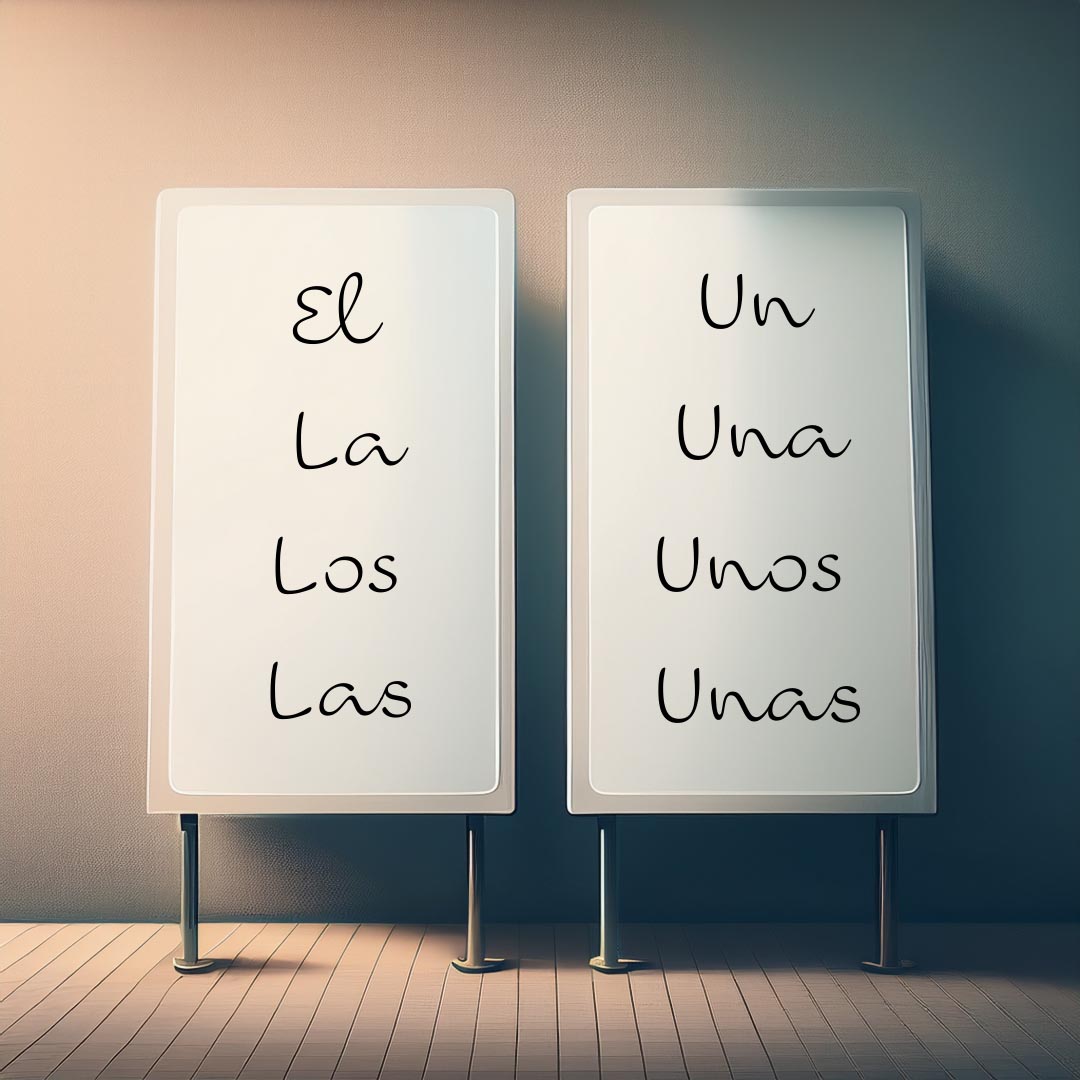
You may have learned that el, la, un, una are called articles. They are, but articles are only one type of determiner. Modern Spanish grammar groups all the small words that introduce a noun into a single, larger category: the determiner.
Think of vehicle as the category and car as one kind of vehicle. In the same way, determiner is the category and article is one kind. Learning the full category gives you the whole picture instead of meeting the rest as exceptions later on.
The Six Types of Spanish Determiners
- Articles (el, la, un, una) — mark the noun as known or unknown.
- Demonstratives (este, ese, aquel) — place the noun near or far.
- Possessives (mi, tu, su, nuestro) — show who it belongs to.
- Numerals (uno, dos, primer, segundo) — count or rank.
- Indefinites (algún, mucho, poco, todo) — refer without specifying.
- Interrogatives and Exclamatives (qué, cuál, cuánto) — ask about or react to the noun.
Each type points to the noun in a different way, but all six follow the same rule.
The Rule That Connects Them All
Whichever determiner you choose, it has to match its noun in gender (masculine or feminine) and number (singular or plural):
- El libro → los libros
- La casa → las casas
- Mucho tiempo → mucha energía
Once your ear learns the gender of the noun, the right determiner often falls into place on its own.
Why This Matters
Determiners are everywhere in Spanish. You can’t form a normal sentence without them. Understanding them as one connected system, instead of six separate lists, is what makes the rest of Spanish grammar start to click.
Ready to practice this with a real teacher?
Book a free 1:1 Spanish class over Zoom with a Spanish Hobby teacher. A native Spanish speaker who teaches with The Spanish Map. No commitment, no pressure.
Or explore where this fits in the bigger picture: try the Map Locator and see how any Spanish word or expression lands on The Spanish Map.