
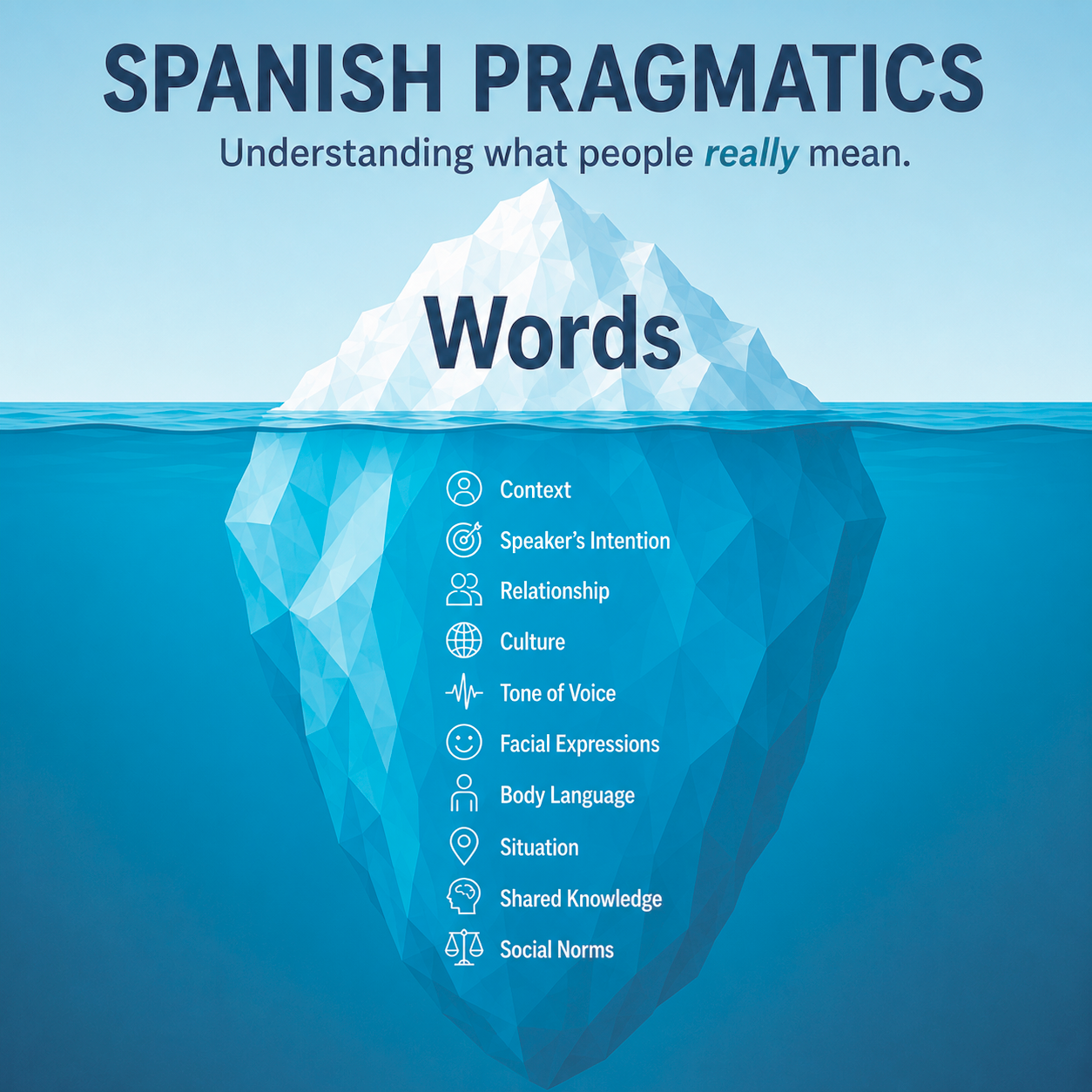
You are at a table with friends and you want the salt. In English you would almost certainly reach for a question: “Could you pass me the salt?”. In Spanish the natural thing to say is “Pásame la sal“, a plain command with nothing softening it, and nobody at that table hears it as rude. The distance between what those words say and what they actually do is Spanish pragmatics.
Pragmatics is the study of meaning in context: what a sentence accomplishes when a real person says it to another real person at a particular moment. On The Spanish Map it sits at the top of The Hidden Structure, just above semantics. Semantics tells you what the words mean, pragmatics tells you what the speaker meant.
This is the layer that decides whether you sound like a person or like a textbook. You can have flawless grammar and still land wrong, because grammar was never the part doing this job. By the end of this article you will understand why Spanish can sound blunt to an English ear when nothing blunt is happening.
What Spanish pragmatics governs
Pragmatics is the layer where the literal meaning of a sentence and its real purpose stop being the same thing. Every language does this, constantly, and speakers stop noticing it in their own.
| What the words say | What the sentence does |
|---|---|
| “¿Tienes hora?“ | asks you to tell the time, not to confirm you own a watch |
| “¿Me pasas la sal?“ | requests the salt, does not ask about your ability |
| “Está un poco caro.“ | often means it is far too expensive |
| “Yo te aviso.“ | frequently means no |
Notice that none of these are idioms. Every word is behaving normally, the sentence is grammatically ordinary, and still the meaning that arrives is not the meaning that was spelled out. That is pragmatics working, and it is the reason a dictionary and a grammar book together are still not enough.
Politeness is built out of different materials
English builds politeness into the words themselves. You pile on modals and hedges: “could”, “would”, “maybe”, “just”, “I was wondering if”. Strip them out and English turns cold, so an English speaker learns to treat that padding as the polite part.
Spanish builds politeness somewhere else: in the verb form, in tone of voice, in the suffix on the end of a word, in the relationship you already have with the person. The sentence itself stays short.
| English pads the sentence | Spanish keeps it short |
|---|---|
| “Could you pass me the salt?” | “Pásame la sal.“ |
| “Would you mind waiting a moment?” | “Espérame un momentito.“ |
| “I was wondering if you could help me” | “¿Me ayudas?“ |
| “Sorry, could I just ask you something?” | “Una pregunta.“ |
Translating the padding is what makes learners sound strange. “¿Podría usted posiblemente pasarme la sal?” is not more polite than “Pásame la sal“: it is stranger, and it puts a distance between you and the person you are eating with. The question forms exist in Spanish and are used all the time, so “¿Me pasas la sal?” is perfectly normal. The point is narrower than that: the direct form is not the impolite one.
The suffix that softens the request
Look again at “Espérame un momentito“. The word is momento with -ito attached, and if you read that as a size marker you will conclude the speaker is promising a shorter wait. They are not. The wait might be ten minutes.
The suffix is not shrinking the moment, it is softening the imposition. “Te llamo en cinco minutitos” does not describe unusually small minutes: it makes the delay feel like less of a burden on you. Morphology built the word, and then pragmatics decided what the word was for. This is one layer of the map handing work directly to another, which is a good reminder that these layers are connected rather than stacked in isolation.
How Spanish says no without saying no
Direct refusal is uncomfortable in most languages, and every language builds its own exits. Spanish tends to keep the door open rhetorically while closing it in practice.
“Yo te aviso” means I will let you know, and sometimes it is literal. Often it is a polite ending. “A ver si nos vemos” translates to something like let us see if we get together, and it usually functions as a warm goodbye rather than a plan. “Está difícil” is not a request for you to solve the difficulty.
An English speaker reads these as unfinished business and follows up, sometimes twice. The follow-up is the mistake, not the original vagueness. The vagueness was the answer.
What English speakers usually get wrong
Attaching por favor to every request. English uses “please” as a routine marker of politeness, so you say “please” dozens of times a day without meaning anything by it. In Spanish “por favor” carries more weight, so putting it in every sentence reads as formal, pleading, or oddly distant. “Me das un café” with a warm tone is friendlier than “Por favor, ¿me podría dar un café?“.
Translating the English hedges. English politeness lives in phrases like “I was wondering if you could” and “would you mind”, and the instinct is to carry them across. “Me preguntaba si usted podría” is grammatically correct Spanish and it sounds like a letter from a bank. Spanish shortens where English lengthens.
Hearing the plain imperative as an order. In English “Pass me the salt” without a question frame sounds curt, so you brace when you hear the Spanish equivalent. “Dame“, “ven“, “mira“, “dime” are ordinary between friends and family, and nothing aggressive is happening. If you refuse to use them, you will sound permanently formal with people who consider you close.
Apologizing on English frequency. English speakers say “sorry” as social lubricant: for bumping a chair, for interrupting, for existing near someone. Spanish separates the small from the serious, so “perdón” and “disculpa” handle the small moments while a repeated “lo siento” suggests something actually went wrong. Over-apologizing does not read as polite, it reads as alarming.
Taking a soft refusal literally. English also softens refusals, but it usually leaves a concrete trace: “I will check my calendar and get back to you”. Spanish can decline with something that sounds like an open door, so “yo te aviso” and “a ver si nos vemos” get filed as pending. Read the tone, not the transcript.
Try it yourself
Recognition: you invite someone to dinner and they answer “Ay, qué rico, yo te aviso“. Decide what has actually been communicated, and what you would do next.
Production: ask a close friend to wait a moment for you. Build it in Spanish without translating “would you mind”, using the short form and the suffix that softens it.
If you managed that without reaching for the English padding, you crossed the line that most learners never cross. You are no longer producing correct sentences, you are producing the right one.
Where this sits on the map
Pragmatics sits at the top of The Hidden Structure, above semantics. Phonetics and phonology gave you the sounds, morphology built the words, syntax arranged them, semantics established what they mean, and pragmatics is the layer that finally asks what a real person is doing with all of it. It is also the border of the pillar: past this point you are in Real World Spanish, where register, region, and culture take over. “Ahorita” is decided here and then handed straight over there.
The practical gain is that you stop grading yourself on correctness alone. Correctness gets you understood, and pragmatics gets you treated like someone who belongs in the conversation. That is the whole argument of The Hidden Structure: the parts of the language you cannot see are the parts doing the most work.
Ready to practice this with a real teacher?
Book a free 1:1 Spanish class over Zoom with a Spanish Hobby teacher. A native Spanish speaker who teaches with The Spanish Map. No commitment, no pressure.
Or explore where this fits in the bigger picture: try the Map Locator and see how any Spanish word or expression lands on The Spanish Map.